Zao Fox Village

The north is pretty far from Gifu, so the first day involved a few stops, the first being at the Zao Fox Village. In Japanese folklore, kitsune are intelligent and magical animals that have the ability to shape shift into humans. Some stories depict them as faithful friends and guardians to humans, but mostly they were said to be tricksters. To avoid being tricked by a cunning and mischievous kitsune, people answer the phone with “Moshi moshi” because supposedly it’s really difficult for foxes to say, so if the person on the other end doesn’t say moshi moshi back, then you know they’re a sneaky fox and aren’t to be trusted!

All the foxes we saw were adorable though, I even played a game with a young one as we chased each other around the enclosure! So now please enjoy these cute pictures of Japanese red foxes!


The soft at heart's who needled a snuggle!


Yamadera

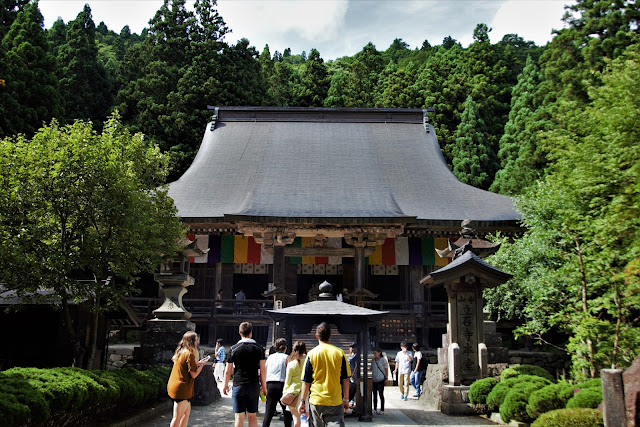
Next up was Yamadera, a thousand year old temple built into the top of a mountain in Yamagata prefecture. You have to climb exactly 1000 stairs through a forest of giant cedar trees, hydrangea bushes, and moss covered lanterns to reach the top. Once you do you are awarded with a beautiful view overlooking a town nestled in the valley below. Yamadera is also famous for being the subject of this famous haiku, composed by Matsuo Bashō, which will probably strike a chord with anyone who has ever had the pleasure of experiencing Japan in the summer!

静けさや
岩にしみ入る
蝉の声
Silence, and penetrating into the rocks — the cry of the cicada


Ginzan Onsen Town

After our hike we were in need of a bath, and what better place to have one then in the beautiful Ginzan onsen town.  Ginzan is a quaint little town nestled in the mountains in Yamagata prefecture that consists of only twenty or so wooden buildings that line a river as it threads its way through a narrow valley. In the evening, after hotel guests have eaten and bathed, they dress in yukata and geta, traditional Japanese cotton robes and wooden sandals, and wander around the town lit by the soft glow of lanterns hanging from each door. It was a magical site, only somewhat ruined by our regular clothes and the fact that we were about to go to an izakaya to drink beers and then retire to our cosy little motorhome for the night! One day we might stay at one of these fancy hotels though, maybe…


Last week we embarked on a journey into the northern region of Tohoku for the best week I’ve had in Japan; the Tohoku Roku! 6 festivals across 6 prefectures in 6 days. 

The festivals line up pretty well so that you can experience most of them on consecutive days:

Fukushima Waraji Matsuri - the first weekend of August (but unfortunately it doubled up with Nebuta this year so we missed it)
Morioka Sansa Odori Matsuri - August 1-4
Akita Kanto Matsuri - August 3-6
Aomori Nebuta Matsuri - August 2-7
Yamagata Hanagasa Matsuri - August 5-7 (it also doubled up with Nebuta so we missed this one too)
Sendai Tanabata Matsuri - August 6-8

It's a hectic, whirlwind trip of the north, and it seems like were not the only ones making the most of these festivals lining up as accommodation in these cities books out way in advance, sometimes over a year in advance! To combat this we had the perfect solution; hire a motor home!


We would drive from city to city, scoping out convenience stores that we could subtly park in (or not so subtly seeing as we were trying to sneak our massive motor home into one of their limited parking spaces) for free for the night. This allowed us easy access to snacks and the amenities; the perfect campsite! As the motor home also didn't have a shower, this left us no option but to indulge in the local onsen we would find along our travels from city to city, leading to some interesting encounters with shocked obaachans who were probably seeing the first ever foreigner that'd stepped foot into their local onsen!


We learned that only 1% of all foreign visitors to Japan venture north into the Tohoku region, so everywhere we went we were greeted with broad smiles, free drinks, and invites to take part in the best matsuri in Japan! So this is the story of how 7 of us crammed ourselves into a motor home, drove over 2300km and visited 6 prefectures in one week, and had some of the most fun in our lives!


For some reason it’s a thing in Japan for most towns to be famous for something. Ogaki (the city Tom works in) is famous for making the wooden boxes you drink sake out of, and Gifu (where we live) is famous for an ancient type of fishing using cormorants. Each town also tends to hold an annual festival where they celebrate the thing they are famous for, which means more fun experiences for us!

Last weekend we went to a festival in a nearby town called Mino which is famous for Mino washi, a special type of paper that’s used to make traditional Japanese lanterns and fans. Similarly to most Japanese festivals, people were dressed up and paraded large Shinto floats around the town while joyously dancing and consuming copious amounts of alcohol (hence the fun)! However, Mino added its own local flair to the traditional parade by hand making hundreds of strands of pink cherry blossoms from Mino washi which they then attached to each float!


|

The men carried around the heaviest floats which they sporadically spun and thew up and down in the air as they paraded through the streets. Each float appeared to have 1 or 2 designated sake distributors, who would continually hold up a wooden barrel with a spout to the men's mouths as they continues along the parade route to help their enthusiasm and perceived strength!


One guy even offered some to Tom as they went passed!


The constant drinking made the float carrying louder, more entertaining and possibly easier for the participants, except for the few who became unable to help carry anymore and instead needed to lean on the float to help them remain standing!


It’s pretty common in Japanese festivals for only men to be allowed to carry the floats, but here the women of Mino carried the first float in the parade, proving that they too are hard core enough to carry around a 1 tonne float while dancing and downing sake!


The children carried their own mini-floats too! 


Until they got tired of it!


These small town festivals are so much fun as a bystander, I can’t even imagine how much fun it must be to be involved in one in your own community! Luckily it's the start of the festival season! But we need to prepare ourselves because that means, summer is coming...


We chose a perfect day to visit USJ: a rainy school day. You think that would keep the crowds away right? Wrong! Supposedly it was much quieter than it could be, but there were still 2 hour long queues for most rides! Luckily, we had 12 hours to spend there!

To start the day we raced straight for Harry Potter World, which is one of the worlds inside USJ. It's by far the most popular part of USJ so you have to line up to receive a timed entry ticket to the world. Because we'd arrived early it was only half an hour before we were wondering through a forest of pine trees with that comforting, magical, Harry Potter music playing in the background! That was until we turned a corner and heard the laughter and excitement erupting from inside the gates to Hogsmeade!


There was the Hogwarts Express at the station, a range of crazy sweets for sale at Honeydukes, wands at Ollivander’s, and wizarding goods at Dervish and Banges! After wondering through all the shops and deciding that we didn't actually need any muggle versions of Skiving Snackboxes or Fizzing Whizbees, we left Hogsmeade in search of Hogwarts Castle!


We found it and couldn't believe how impressive it looked! If you look closely you can see Harry and Ron weaving between the turrets on their broomsticks!


‘The Forbidden Journey’ ride is inside Hogwarts Castle. Being the most popular ride in the park, it had a queue a few hours long. Pre-empting this, the park made the queue wind through Hogwarts, giving you plenty to see during the wait. We passed through Professor Sprout’s greenhouse and Dumbledore’s office, and passed talking portraits and the Sorting Hat (all speaking in Japanese though)! The ride was the best 4D ride I’ve ever been on! It felt incredibly real flying around the castle and ducking under bridges, playing Quiddich and trying to catch the Snitch, and escaping the Dementors where you could see your face bring sucked into their mouths as they tried to kiss you! Luckily we escaped with the help of the famous Griffindor trio!

To celebrate we feasted at The Three Broomsticks. A huge platter of meat and vegetables was served with either a brew from the Hogs Head or a delicious cup of Butterbeer, which tasted like liquid cake! I’m still dreaming about how good the Butterbeer was and wishing that I could find Hermione to enchant my keepsake cup to be a never ending one!


Because we visited USJ around Halloween, come 6pm the park became infested with zombies! These zombies were incredibly scary and would limp after you, groaning with arms outstretched or carrying chainsaws! There was a SWAT team on patrol that occasionally were able to take control of a zombie and put them in the back of their van, but if they weren’t careful, just down the road the SWAT team would burst out of the van having been turned into zombies! The only way to escape the zombies was either to run fast, or wait for the music to start every half an hour, upon which the zombies became transfixed and would start dancing to this scary song:


The next time I come back to experience the magic, the snow on the rooftops will be real, and I'll be with a group of crazy muggles who have decked themselves out as Hogwarts wizards and witches (aka my family)!!
Working on weekends has its perks. Two weekends ago a group of us used our days off in lieu to make a long weekend out of the Halloween weekend and headed to Osaka! The weekend wasn’t filled with any cultural excursions, just Halloween parties, eating Osaka’s infamous street food, visiting the Glico man, and of course the main reason we visited Osaka: to visit Harry Potter World at Universal Studios Japan!

Racing along with the 80 year old Glico running man billboard.
After arriving at the busy Osaka station in full costumes and face paint for some, we made our way through the busy streets to the club our party was being held at. What was supposed to be a 10 minute walk was closer to 45 minutes, and ended up being the best part of my night! The long walk was due partly to people asking to take their photos with us, but mostly me asking to take photos of other people! Check out some of the cool costumes below:

Cloud and Aerith, the all male Power Rangers, the Teletubbies with Princess Mononoke, and 2 Madelines with an adorable little girl. 
The incredibly scary zombie, cross-dressing Sailor Senshi! 
The not so scary Monkey D. Luffy and Minnie Mouse! 

One of our days consisted purely of going from breakfast, to lunch, to dinner! We went to a lovely English tea house in the morning where I had real Eggs Benedict and a pot of Chai tea! Unheard of in Japan to me until now! After walking for an hour or two and not knowing what else to do, we tried some of the local specialties. We had Okonomiyaki, which is a Japanese savoury pancake where you choose the ingredients (pork, squid, cheese etc.) and grill it on a hotplate. We also tried Takoyaki, small balls of batter with a piece of squid inside, grilled on special hot plates that look really similar to a Poffertjes hotplate. After a nap at home, it was out again for some delicious Mexican food and frozen margaritas! Ahhh Osaka, my waist line does not love you!

When I closed my eyes it felt like I was back at Tilleys! Apart from the side salad though, that was a bit random.

We stumbled across what appeared to be a huge, unused, unorthodox ferris wheel while meandering between meals.

I know these Okonomiyaki don't look very appetizing but they were delicious and Tom's favourite meal of the trip!
MANGO MARGARITAS!! 

The highlight of the trip though was our final day, when we visited Harry Potter World at Universal Studios Japan!! Stay tuned for the next installment to read about the magic of Hogsmeade and Hogwarts!
October is one of the best months in Japan because of the spectacular yellow, orange and red autumn colours that can be seen amongst the changing trees. What better way to observe this fiery brilliance than by hiking through the national parks in Norikura? So a few weekend ago, that’s what we did!

A group of us set out nice and early and headed for Mt Norikura, a dormant volcano in Gifu prefecture. As we drove further north, we headed away from the last wisps of summer in Gifu city, through the gorgeous autumn scenery, and eventually up the mountain, where winter had well and truly arrived.


The weather wasn’t as pleasant as the views on the first day, so instead of hiking to the summit we decided to do some of the waterfall hikes instead. Due to the lack of signage (or more likely our lack of Japanese), we took what we thought was the long walk to the most popular waterfalls. Instead of heading right, up the well-trodden mountain path, we of course went left and started climbing our way up a ski slope. None of us thought it unusual when the track disappeared, or when we saw no people around and just large ski signs indicating black and blue runs behind us. We could always hear the waterfall to our right, so we weren’t too worried, that was until the noise of crashing water started disappearing… As we deliberated whether to turn back around or to continue, we came upon another carpark, except there was a huge chain blocking access to the path we happened to be walking along, whoops! Somehow, we had made our way to the other carpark where the short walk to the waterfalls began! This path was of course perfectly marked out with wooden steps and signs every few hundred metres. The Sanbondaki waterfalls consist of 3 separate waterfalls that flow in to one river. They were beautiful, and not just because we hiked 2 hours to get there!


Can you see all 3 waterfalls? The all flow into the one river just below us.


We finally found the right path! Yay!


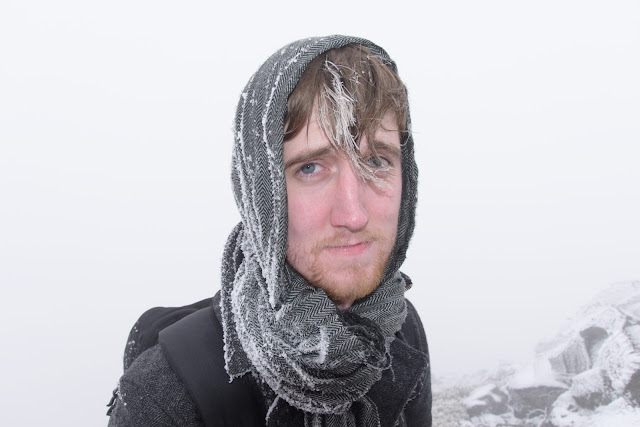
The following day we awoke to clear blue skies and were stoked that we chose today to walk to the summit of the volcano! After just making the early bus, we were driven up the windy, narrow road to the level of the clouds where the hiking began. The bus took us past trees covered in stunning autumn coloured leaves, but these eventually started to disappear and instead made way to a barren ice land shrouded in fog. Everyone laughed when I said to pack warm clothing, they weren’t laughing anymore!


The beautiful autumn weather!
Mitch half frozen to death, definitely not laughing anymore.
The howling wind brought the temperature down below zero and covered whatever was still standing in icicles (this included us)! Unfortunately, the weather was terrible in the clouds and we never made it to the point that we were above them. Instead of the clear views of other mountains from the summit, we couldn’t see more than 20m and were covered in ice! Granted, the frozen tori gate at the top looked pretty cool in this weather!

Check out how the icicles have formed in the wind off the back of the Torii gate!
Despite the atrocious weather, it was still a really fun and memorable trip. We might just have to do it again, but maybe in summer instead!
Last weekend was the 415th anniversary of the Battle of Sekigahara. This battle was the largest and most decisive samurai battle in Japanese history. To celebrate the event we attended the Sekigahara Matsuri and samurai school! Firstly though, for those of you that don’t know the story, I’ll give you my rendition of it now. For those of you that would prefer a super short summary, you can skip to about half way down the page instead!


The not so super short summary:
Oda Nobunaga was a great samurai who unified most of Japan and became the Shogun back in the 1500's. The Shogun was the country’s Military Commander and he effectively ran the country. Officially the Emperor was the highest rank, but the Emperor rarely had any power so the Shogun tended to run the show. Nobunaga was betrayed by one of his closest comrades who wanted the power for himself, so he committed seppuku, the honourable samurai suicide where they slice their stomach open, so that the betrayer wouldn’t get the glory of killing Nobunaga himself. This left Japan without a leader, until a loyal successor called Toyotomi stepped up and fought to preserve Nobunaga’s name and legacy. Toyotomi managed to maintain power and peace in Japan for 20 years before dying and leaving only a 5 year old son as his heir.

               Oda Nobunaga                                     Toyotomi Hideyoshi                                  Tokugawa Ieyasu
A political officer called Ishida, a Toyotomi clan loyalist, decided to act as a figurehead and help rule the clan until the young boy came of age to be able to rule himself. However, one of the highest ranked military lords in the clan, Tokugawa, decided it was his time to shine and saw the opportunity to gain power for himself! He split the clan in half, taking control of all the military generals, and leaving all the loyalists to Toyotomi. Of course, two leaders doesn’t work very well, so this indecisive period resulted in the epic Battle of Sekigahara.

Ishida tried to trick Tokugawa by forming a secret pact with an Eastern Lord who would raise his army against Tokugawa and draw him east into a battle. Tokugawa took half the samurai army in Osaka and marched them east to settle this rebellion. Ishida then took the other half of the army, rallied more lords and their soldiers from the west and marched to try and take Tokugawa by surprise. But Tokugawa was too clever and he discovered the trick. Firstly, he made sure his samurai would support him in battle and not turn on him for loyalty to the Toyotomi clan. They all agreed, but they were still greatly outnumbered. Secondly, Tokugawa was a very clever man and so he managed to convince a few of Ishida’s eastern lords to secretly pledge their allegiance to him instead of Ishida, and they were only to reveal this during the battle.

Ishida thought he had this battle in the bag. He had a much larger army, and he got to the battlefield first so he was able to strategically place his army around the mountains of Sekigahara. He even managed to position part of his army on a mountain to the east and south of the battlefield, so that when Tokugawa’s army came through the eastern valley Ishida’s armies could surround Tokugawa’s in a brutal sandwich! Unfortunately, Ishida didn’t realise how clever a man Tokugawa was.

On the day of the battle, Tokugawa’s army came through the eastern valley and started to fight on the battlegrounds between the east and west mountains as planned. However, when Ishida sent the signal for his eastern mountain army to come down and surround Tokugawa, two of his armies turned on him instead and decimated his side within hours.

After winning the battle, Tokugawa returned to Osaka, where he was declared the next Shogun by the Emperor and began the 265 year reign of the Tokugawa Shogunate This period of time is called the Edo period, and is when Japan shut themselves off from the rest of world. This resulted in the longest period of peace in Japanese history, and enabled the Japanese culture to develop with limited influence from the outside world to become the incredibly unique culture it is today.


The super short summary:
Two great Samurais, Oda Nobunaga, and his successor, Toyotomi Hideyoshi, successfully unified all of Japan. Unfortunately, when Toyotomi died, he left only a young child as his heir, and this threw Japan into disarray. Two men then both decided that they should be the new leader and fought the largest battle Japan had ever seen on the battlefields of Sekigahara (30km west of Gifu city). A man named Tokugawa won after employing some clever and sneaky tactics, and was declared the Shogun of Japan. His family’s reign as Shogun lasted 265 years and is known as the Edo period, which was the period of time where Japan closed itself off from the rest of the world and developed the incredibly unique Japanese culture we see today.


The Matsuri:
While in Sekigahara we checked out the museum which had the actual samurai swords used in the battle (cleaned of course), the battlefields, and the decapitation area! Also, being a Japanese festival, there were many performances, food stalls and adorable festival mascots! Japan loves having cute mascots for everything and anything, and this was no exception. They managed to make the dangerous war lord, Tokugawa, look cute in his soft and oversized samurai costume. There were also a few different cats dressed as samurais roaming around the festival, just in case one mascot wasn’t enough!

Tokugawa mascot
A range of the adorable samurai cats! 

The Lord Generals awaiting the next head for inspection at the decapitation area. 

Samurai School:

We started the day by getting dressed into basic samurai clothes, which were pretty much just comfortable cotton pajamas and uncomfortable size 6 straw sandles! Once we were dressed appropriately, we had a lesson on how to wield a sword and a spear. Hot tip: if you’re ever in a battle, always choose a spear! A swordsman will rarely get near you if you’re poking at them with a 5m long spear! We then got to try on some samurai battle gear and fought each other again! It was pretty fun, but Tom didn’t follow the instructions and improvised his own moves, so I died a few times. Second hot top: always choose Tom to go into battle with you over me. According to our certificated, in the spirit of the samurai we successfully and honourably learned and used the weapons and armour of the samurai like a pro (minus the like a pro part).


Learning the overhead slice action with a katana

If looks could kill! (Probably has a better chance than his plastic spear).

One of the many times Tom killed me in battle! (Always choose the spear...)

The students of Samurai School